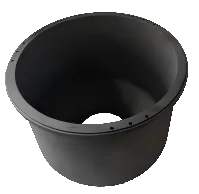
Why are there small holes on the CFC external diversion tube?
By Lucy (Sales) @ semicera semiconductor technology co., ltd.
The CFC external deflector tube features a circular edge composed of flange edges and annular air holes. These air holes are not designed arbitrarily but are tailored to the thermal field structure, airflow control, and installation fixation requirements.
1. Airflow guidance effect
Within the crystal growth furnace, high-temperature gases flow continuously. If the flow guide cylinder is completely sealed, the hot gases cannot exchange uniformly, and localized airflow stagnation may occur, leading to vortex formation and localized overheating. Therefore, flow channels must be established through the guide holes to maintain pressure equilibrium inside the furnace and ensure a stable heat transfer path.
Semicera enhances the uniformity of the furnace temperature field and reduces local temperature fluctuations by controlling the cross-sectional area of the airflow channels, thereby regulating gas flow velocity and direction. This improves crystal growth stability. Semicera understands that during crystal growth, temperature gradients and airflow stability directly influence defect formation, microtube density, and growth rate; thus, pore design is critical. Semicera customizes distinct pore configurations based on customer requirements and operational conditions to meet specific needs.
2. Thermal stress
As is well known, CFC materials exhibit a low coefficient of thermal expansion, excellent thermal shock resistance, and good high-temperature stability. However, at temperatures above 2000°C, temperature gradient stresses and structural stress concentrations still occur. Moreover, the flow guide cylinder features a large-sized thin-walled structure that must withstand prolonged high-temperature cycling operations. If entirely pore-free, thermal stresses will concentrate, leading to edge cracking and eventual deformation with extended use.
Therefore, by designing the release openings, Semicera can interrupt the stress transmission path and distribute local thermal stresses, thereby extending the structural service life. The design of Semicera incorporates finite element thermal stress analysis (FEA), thermal field simulations, and actual furnace cycle life data to determine the aperture size and positioning.
3. Temperature Field Regulation
The external deflector tube itself also serves as a thermal radiation regulation component, while CFC is a high-temperature radiation material. The aperture ratio in different regions affects the thermal radiation exchange efficiency. In other words, a higher number of openings leads to faster local heat dissipation and a relative temperature reduction, whereas fewer openings provide better thermal insulation and more concentrated heat distribution.
Semicera adjusts the number, distribution, symmetry, and aperture ratio of pores based on crystal size, growth method, and heating configuration to achieve optimal thermal field performance.
4. Installation Positioning and Structural Fixation
Certain holes also serve for installation and fixation, coaxial positioning, and thermal field assembly. Given the numerous layers of thermal field components within the crystal growth furnace, the stringent coaxial precision requirements, and the complexity of thermal expansion compensation, precise assembly must be achieved through these hole positions.
Why are CFCs more suitable for this structure?
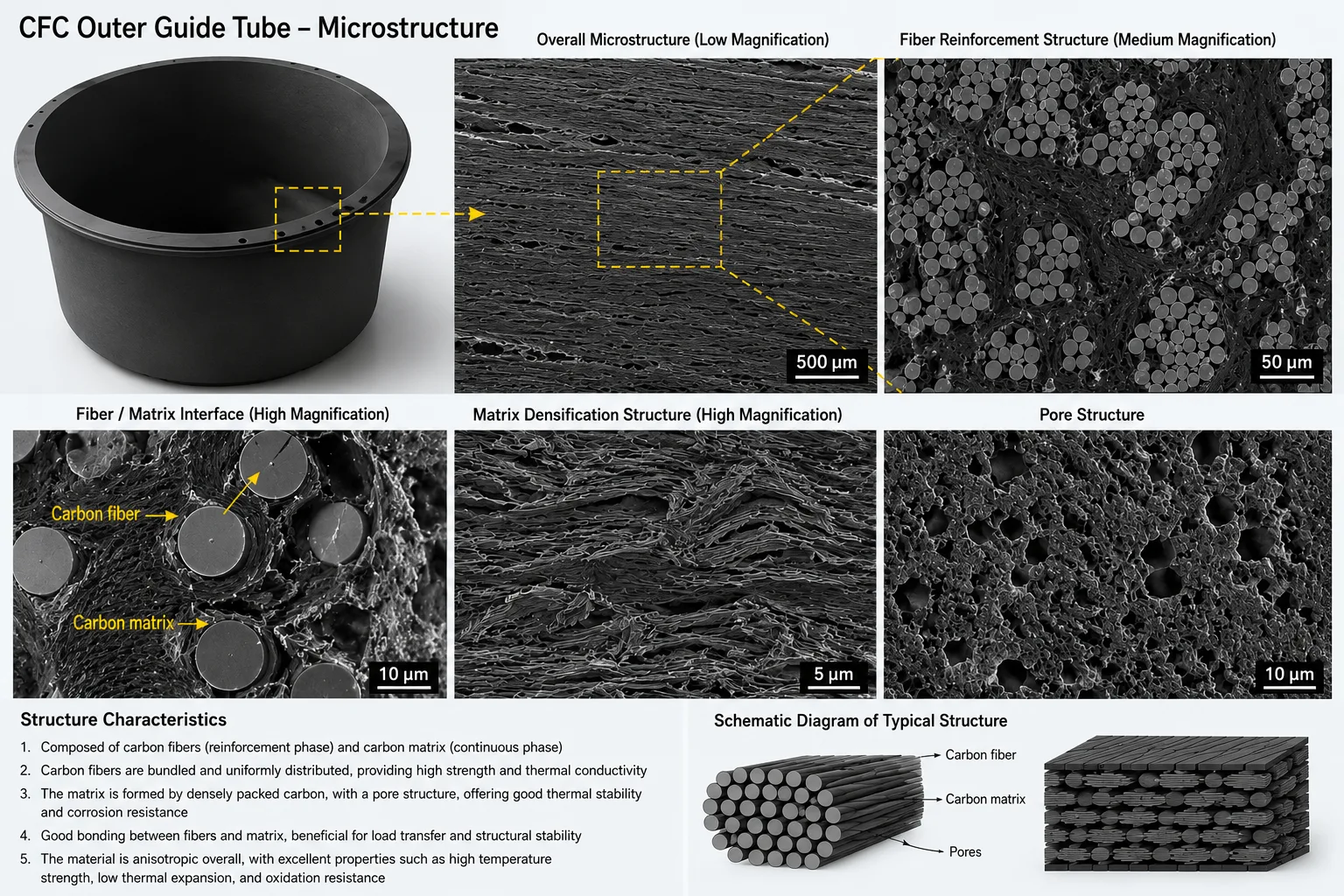
Compared to traditional graphite, CFC exhibits higher mechanical strength, lower thermal expansion, superior thermal shock resistance, and a longer service life. Consequently, even after timely perforation processing, it maintains high structural stability.
Semicera’s CFC external diversion tube
Semicera adopts a combined densification process of chemical vapor deposition (CVD) and liquid-phase impregnation, effectively solving the issue of uneven density commonly found in pure CVD processes. At the same time, high-purity and high-performance resin impregnation is utilized to achieve higher densification efficiency, shorter production cycles, and longer product service life.
In addition, through optimized microstructure design, the product features low porosity at R-angle areas, excellent corrosion resistance, and minimal particle shedding, ensuring the purity of silicon materials during operation.