
The differences between CFC-filled insulation cylinders and other CFC components
By Lucy (Sales) @ semicera semiconductor technology co., ltd.
The primary distinction between CFC hard felt insulation tubes and other CFC structural components (such as CFC crucibles, CFC flow tubes, and CFC support rings) lies in the fact that CFC hard felt insulation tubes serve as insulating materials rather than load-bearing structural components. Consequently, they differ in microstructure, density design, porosity, thermal conductivity mechanisms, strength orientation, and manufacturing processes.
構造
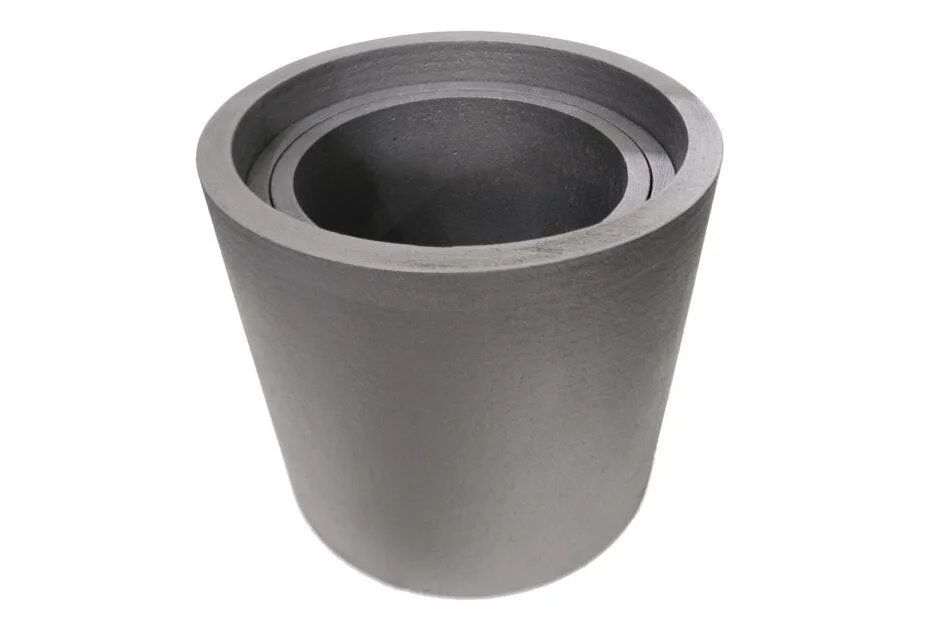
CFC hard felt insulation tubes prioritize low thermal conductivity, high porosity, low density, and excellent thermal barrier performance. Unlike conventional CFC structural components—which feature a carbon fiber + carbon matrix configuration—they employ a random fiber network with numerous micropores. This unique structure results in significantly higher porosity due to the abundance of micropores. Meanwhile, the CFC hard felt insulation cylinder is of a hollow cylindrical structure with multiple layers superimposed.
The product adopts a “high-porosity structure” because the pores themselves serve as an “insulation layer.” From a material science perspective, the more difficult heat transfer is continuous, the better the thermal insulation performance; the high-porosity structure effectively blocks heat conduction pathways.
Density design
The remaining CFC structural components typically have a density of 1.4–1.9, as they require sufficient strength. In contrast, CFC rigid felt insulation tubes generally have a density of 0.12–0.25, resulting in extremely low weight, minimal thermal inertia, and rapid heating performance.
Semicera exhibits a density of ≤0.18, lightweight properties, and low thermal inertia, along with an excellent heating rate.
Thermal conduction mechanism
Conventional CFC components require rapid heat conduction and uniform temperature distribution across the thermal field, necessitating highly continuous fiber structures. However, the CFC hard felt core functions to block heat flow: it insulates through its pores, reduces solid-state heat transfer, disperses heat at fiber interfaces, and employs a complex structure that reflects infrared radiation at high temperatures, thereby dissipating radiative energy.
Mechanical Design
Conventional CFC structural components prioritize strength, rigidity, and load-bearing capacity—such as those supporting crystals or graphite structures. In contrast, rigid felt insulation sleeves emphasize dimensional stability without collapse or slag discharge, and are not designed to withstand heavy loads.
セミセラ
To address issues such as fiber shedding and powder detachment, Semicera employs a surface densification process that utilizes CVI, PyC deposition, and resin curing to form a “hard shell layer,” thereby reducing fiber detachment. Additionally, Semicera applies a pyrolytic carbon coating to the surface. This coating features high purity, a dense surface, and high-temperature resistance, making it ideal for SiC crystal growth, semiconductor annealing, and applications in thermal environments.
Therefore, Semicera also recommends that customers apply a coating to extend the product’s service life.
Why are high-end heating fields increasingly adopting the “composite hard felt structure”?
Although pure rigid felt offers excellent thermal insulation performance, its low strength makes it prone to collapse and deformation. Therefore, manufacturers typically employ a “CFC skeleton + rigid felt insulation layer” structure.
The typical structure consists of:
outer layer – a CFC load-bearing frame;
middle layer – a rigid felt insulation layer;
inner layer – a PyC/graphite paper protective layer.
The outer layer ensures structural stability, the middle layer provides thermal insulation, and the inner layer maintains cleanliness and prevents powder shedding. This configuration represents the most prevalent design for semiconductor thermal fields, SiC crystal growth furnaces, and large-scale photovoltaic thermal systems.
Why adopt the structure of a “hard felt insulation cylinder”?
In a high-temperature furnace operating at 2000°C, heat loss primarily occurs through “radiation + conduction.” Since a single rigid CFC board insulation provides insufficient economic efficiency, a multi-layer rigid felt combined with a CFC skeleton structure is employed. This configuration reduces thermal conductivity, decreases energy consumption, enhances temperature field uniformity, and mitigates thermal stress concentration.