Innovation in Industrial High-Temperature Thermal Field Components — CFC Support Ring
By Lucy (Sales) @ semicera semiconductor technology co., ltd.
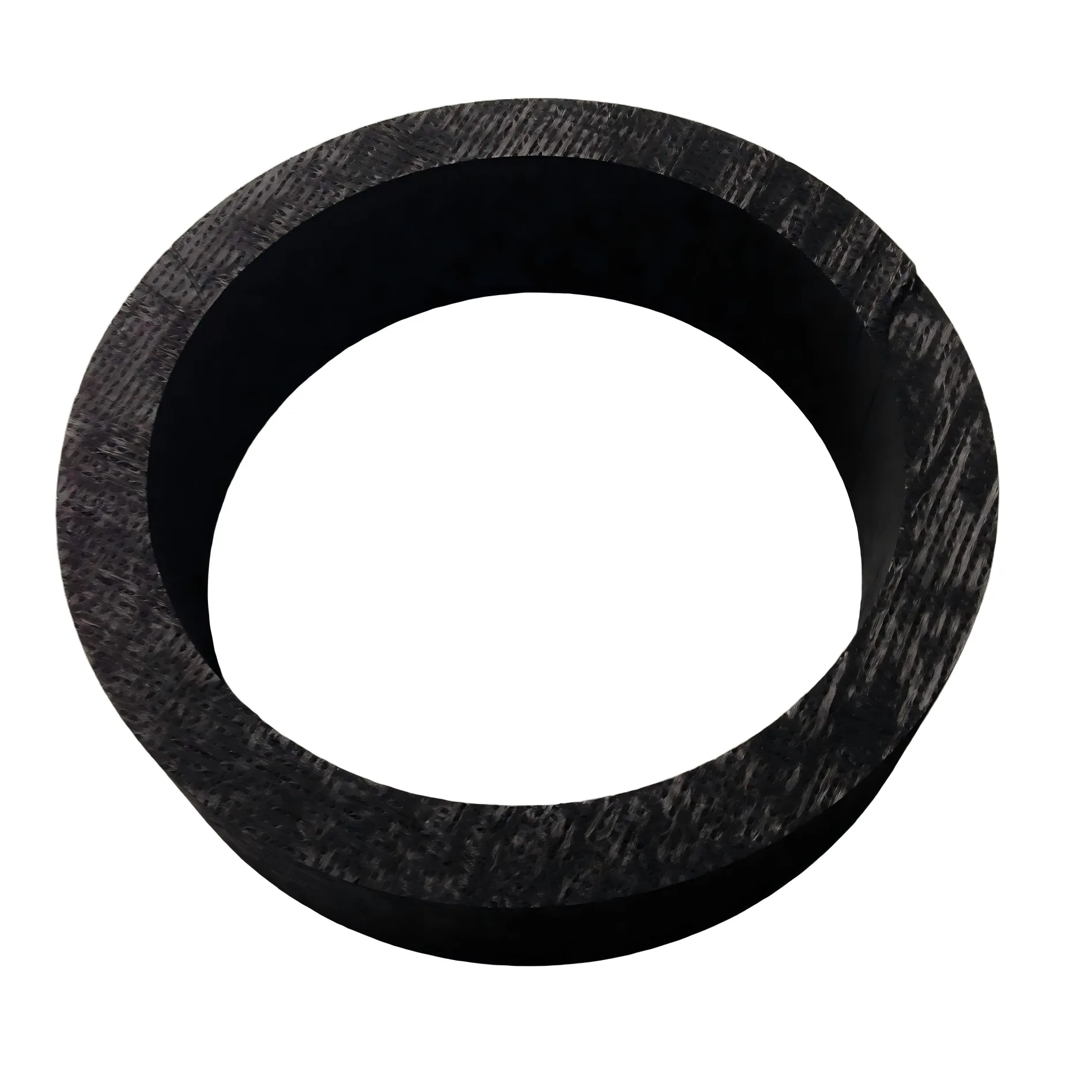
CFC (Carbon Fiber-reinforced Carbon) support ring is a high-performance circular component made of carbon fiber-reinforced carbon composite (C/C composite). It integrates high-strength carbon fibers with a carbon matrix, featuring low density, high specific strength, low thermal expansion coefficient, excellent thermal conductivity, and outstanding high-temperature resistance.
Introduction to the CFC Support Ring
그만큼 CFC support ring, also known as a carbon fiber-reinforced carbon-based composite support ring, is a high-performance structural component fabricated using carbon fiber as the reinforcement and carbon as the matrix through carbonization and graphitization processes.
It is typically employed in industrial environments characterized by high temperatures, severe corrosion, or extreme loads, such as monocrystalline silicon growth furnaces and high-temperature vacuum furnaces in the photovoltaic and semiconductor industries.
Due to its resistance to softening and deformation at elevated temperatures, the CFC support ring significantly extends the service life of high-temperature furnace components and reduces operational energy consumption, thereby gradually replacing graphite support rings.
Why choose CFC support rings instead of graphite support rings?
Traditional graphite support rings exhibit several inherent limitations under high-temperature thermal conditions: Under prolonged exposure to temperatures between 1200–1650°C, graphite undergoes significant creep and performance degradation, leading to dimensional instability issues such as warping, sagging, and deformation over extended use, thereby failing to maintain coaxiality and flatness consistently. Additionally, their moderate thermal shock resistance makes them prone to micro-cracking, edge chipping, or even fracture under frequent temperature fluctuations, substantially reducing service life and increasing the risk of unplanned downtime.
Graphite exhibits relatively low compressive strength (approximately 90 MPa) and elastic modulus (20–25 GPa). Under prolonged thermal stress and mechanical loads, its structural integrity becomes compromised, making it prone to issues such as fracture, powder shedding, and delamination. These defects lead to furnace chamber contamination and adversely affect the yield of wafers or epitaxial wafers.
Furthermore, the graphite-supported rings have a short service life and require frequent replacement, which not only increases spare parts procurement costs but also significantly raises labor expenses and time consumption due to repeated shutdowns, disassembly, calibration, and maintenance, resulting in persistently high overall operational and maintenance costs.
Although graphite has a low initial procurement cost, its insufficient stability and reliability over the long term ultimately increase the total lifecycle cost, failing to meet the stringent requirements of next-generation crystal growth furnaces and epitaxial equipment for high precision, long service life, and low maintenance needs.
To meet the stringent requirements of next-generation crystal growth furnaces and epitaxial equipment, the CFC material support ring has been introduced!
Comparison between the CFC supporting Ring and the Graphite supporting Ring
To facilitate a more intuitive comparison of the performance data between CFC support rings and graphite support rings, a table is provided below:
|
목 |
CFC Support Ring |
Graphite Support Ring |
|
Material Structure |
Carbon fiber reinforced carbon (composite) |
Polycrystalline graphite (monolithic) |
|
Max Operating Temperature |
≥ 2000°C |
~1800–2200°C |
|
Creep Resistance |
Very low (high dimensional stability) |
Noticeable creep (risk of deformation) |
|
Thermal Shock Resistance |
· Very Strong (fiber-reinforced structure) |
보통의 |
|
Compressive Strength |
220–380 MPa |
~90 MPa |
|
Elastic Modulus |
~95 GPa |
~20–25 GPa |
|
밀도 |
1.45–1.6 g/cm³ (lighter) |
~1.8 g/cm³ |
|
Structural Stability |
Maintains geometry over long cycles |
Deforms over time under high temperature |
|
서비스 수명 |
2–5× longer than graphite |
Shorter lifespan |
|
Replacement Frequency |
낮은 |
높은 |
|
Initial Cost |
높은 |
낮은 |
성능
Since the material of the CFC support ring is identical to that of the CFC material, its performance reflects that of the CFC material:
Low density: Density ranges from 1.45–1.6 g/cm³, 10%–20% lower than graphite;
High carbon purity: Carbon purity ≥99.5%, with impurities reduced to <50 ppm after high-temperature purification;
Controllable porosity: The porosity can be adjusted to meet thermal insulation and breathability requirements, typically ranging from 5%–15%;
Low water absorption: Water absorption <0.5%, extremely low after densification.
Semicera’s CFC support ring
Semicera adopts a quasi-three-dimensional structure with an exceptionally high carbon fiber content exceeding 70% stability. The manufacturing process employs hot pressing and resin impregnation densification techniques, featuring a streamlined and controllable production workflow with high efficiency that significantly reduces the overall production cycle.
In addition, Semicera’s CFC support rings feature a density of up to 1.35 g/cm³, with tensile strength ≥150 MPa 그리고 flexural strength ≥120 MPa—offering a significant advantage over products from other manufacturers.
Compared to CFC materials produced by pure vapor-phase deposition, this material exhibits superior mechanical properties under identical density and carbon purity conditions. For this reason, Semicera employs a combination of hot pressing and resin impregnation densification processes, delivering exceptional mechanical performance while balancing high efficiency with cost-effectiveness. This approach makes the material particularly suitable for demanding applications such as semiconductor thermal environments and support structures in high-temperature furnaces.
Technology
Since the material of the CFC support ring is the same as that of the CFC material itself, the manufacturing process is largely identical to that used for producing the CFC material.
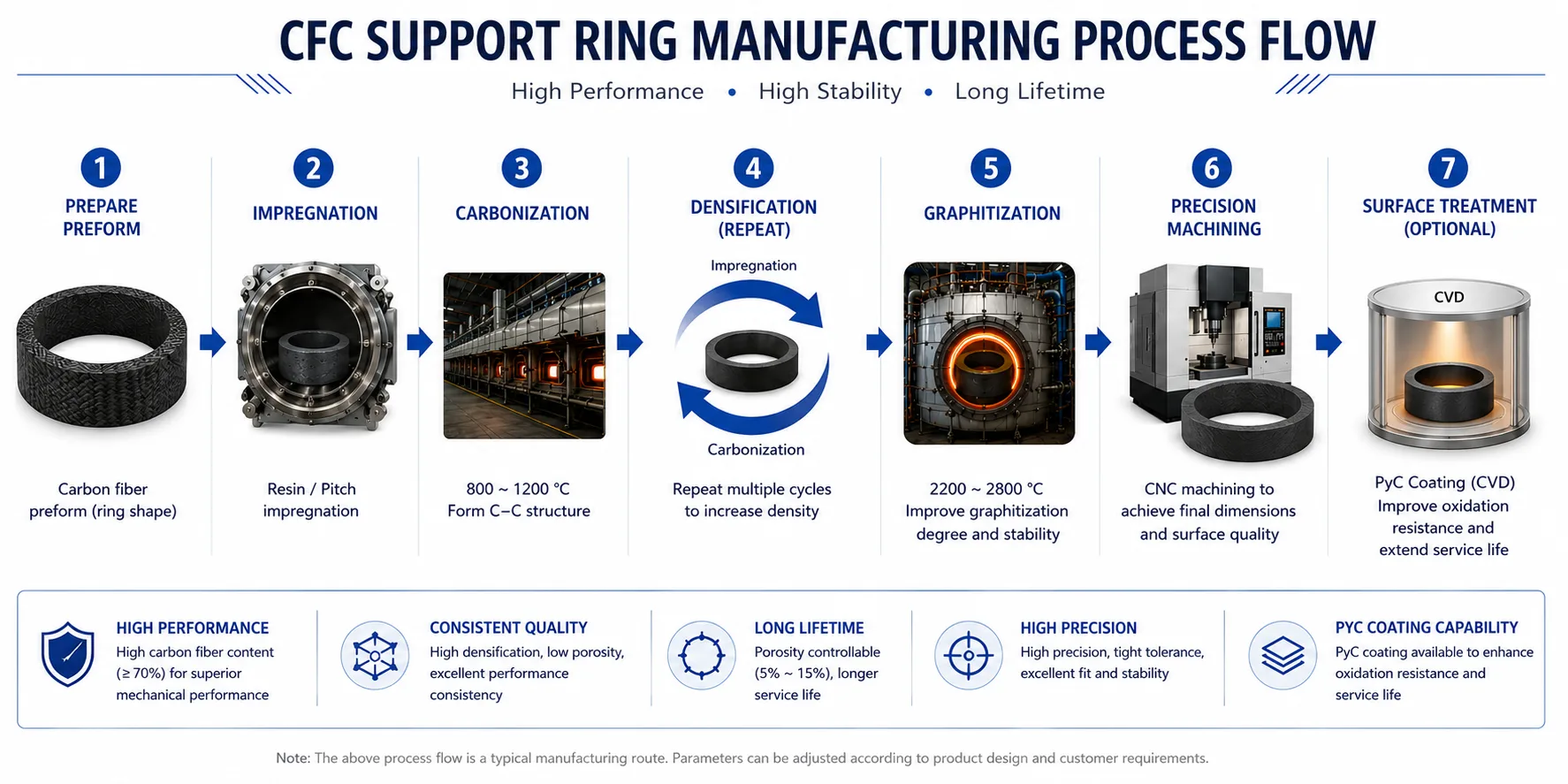
1. Preparation of Carbon Fiber Prefabricates
Using carbon fibers (short-cut fibers, fiber mats, or fabrics) as raw materials, Semicera processes the materials through layering, three-dimensional needling, and molding to form annular preforms. This process simultaneously enhances interfacial strength, improving both crack resistance and strength orientation, ultimately yielding porous carbon fiber preforms.
2. Immersion (first densification)
After forming the preformed ring, Semicera employs a vacuum impregnation process, where resin or asphalt is pressurized to penetrate the interior of the fibers, resulting in a composite green body containing an organic matrix.
3. Carbonization
After impregnation, Semicera subjects the organic material (resin/asphalt) to carbonization to convert it into carbon and form a carbon-carbon structural framework.
Upon heating at 800°C–1200°C, the resin/asphalt undergoes pyrolysis, releasing gases (e.g., H₂, CH₄) while leaving solid carbon. Following carbonization, the resulting carbon fiber with carbon matrix forms a CFC structure; however, a single cycle of impregnation and carbonization yields a porous CFC structure.
To extend service life, Semicera performs multiple densification processes to continuously fill pores, enhancing density and strength.
Lower porosity corresponds to greater strength and longer service life.
The number of treatment cycles varies across facilities, leading to significant differences in service life. Semicera customizes the process according to customer requirements.
4. Graphitization
After completing several rounds of densification processes, Semicera implemented a graphitization procedure to enhance the performance of the CFC support ring. At high temperatures ranging from 2200°C to 2800°C, this process transforms disordered carbon into a graphite structure, thereby improving thermal conductivity, mechanical properties, and high-temperature stability.
5. Precision mechanical machining (forming support ring)
Upon completion of the high-performance CFC support ring, Semiera’s CNC machining center performs precision finishing on the component, including inner and outer diameter machining, flatness control, and slot structure optimization, ultimately producing a flawless and precise CFC support ring.
6. Surface treatment (optional but critical)
Some customers require the CFC support ring to have a longer service life and possess certain anti-oxidation and anti-corrosion properties. Therefore, Semicera also offers coating services, primarily pyrolytic carbon coatings.
Why choose pyrolytic carbon coating?
Given our experience with post-sale incidents involving corrosion of carbon-carbon crucibles, we recommend the pyrolytic carbon coating.
At high temperatures, the quartz crucible reacts with molten silicon to produce SiO₂ gas:
Si02+ Si→ 2Si0(g)
These SiO₂ gases diffuse outward and react upon encountering CFC (carbon):
The SiO+C→SiC+CO reaction generates SiC on and within the CFC surface, accompanied by approximately 2.2-fold volume expansion, leading to matrix cracking, corrosion, and spalling.
The pyrolytic carbon coating forms a pore-free, dense carbon layer on the CFC graphitic surface via chemical vapor deposition, completely sealing all pores and micro-cracks in the substrate. This prevents SiO₂ and Si vapor generated from the reaction between the quartz crucible and molten silicon from penetrating the material, thereby blocking the pathway for the SiO + C → SiC reaction at its source.
Additionally, the thermal expansion coefficient (CTE) of the pyrolytic carbon coating is nearly identical to that of the carbon-based material. During high-temperature cycling, the coating and substrate experience no internal stress due to thermal expansion and contraction, exhibiting no cracking or peeling.
Furthermore, the coating can withstand prolonged exposure to temperatures between 1400–1600°C and repeated thermal shock cycles, demonstrating a significantly longer service life compared to other coatings.
Therefore, Semicera recommends opting for the pyrolytic carbon coating to further extend service life! If you wish to apply the pyrolytic carbon coating to your existing products, please feel free to contact us. Besides, Semicera recommends you choose the density of 1.3/1.4g/cm³. At this density, the surface densification process performs well, effectively preventing gas ingress.
Use of the CFC support ring
The CFC (Carbon Fiber Reinforced Carbon Composite) support ring is a critical structural component for semiconductor, photovoltaic, and high-temperature furnace thermal systems.
With its exceptional properties—including high-temperature resistance, high strength, low creep, and thermal shock resistance—it is primarily used in the following applications:
-semiconductor SiC single
-crystal growth furnaces (silicon epitaxy/silicon carbide epitaxy furnaces, MOCVD/CVD equipment);
-photovoltaic single-crystal and polycrystalline silicon Czochralski growth furnaces;
-and vacuum heat treatment/sintering/brazing furnaces.
Choose Semicera!
Still troubled by the high-temperature deformation, cracking, powder shedding, and frequent replacement of graphite support rings? Choose Semicera – it will be your solution.
Semicera’s CFC support ring features a high-carbon fiber quasi-three-dimensional structure and is manufactured using resin-impregnated densification technology, delivering exceptional compressive strength and a significantly longer service life than graphite support rings. It not only ensures stable temperature distribution in your equipment but also substantially reduces spare part procurement and downtime maintenance costs, making it the ideal choice for upgrading thermal field components.
Leveraging a mature supply chain, comprehensive equipment and manufacturing processes, and years of industry collaboration experience, we offer end-to-end services ranging from customized design and precision machining to surface coating to meet your diverse requirements. Meanwhile, Semicera continuously enhances its manufacturing processes, ensuring stable product quality and reliable delivery efficiency to support your production needs.
In addition to CFC support rings, Semicera also produces other thermal field components—including support rings in various specifications, crucibles, crucible holders, flow guides, insulation tubes, and heaters—to cater to different customer requirements.