
Why CFC Upper Insulation Covers Use Hot Pressing + Resin Impregnation Densification Instead of Pure CVD?
By Lucy (Sales) @ semicera semiconductor technology co., ltd.
Process Overview: Hot Pressing + Resin Impregnation Densification
Process flow:
- Carbon fiber preform (CFC skeleton)
- Resin impregnation (liquid precursor fills internal pores)
- Hot pressing/curing
- Carbonization + multiple densification cycles
- SiC coating/graphitization treatment
This process combines liquid-phase infiltration and multi-cycle densification, enabling a balance between structural strength, controlled density, and high-temperature stability. It is widely used in semiconductor thermal fields, photovoltaic systems, and high-temperature furnace applications.
Advantages
1. Suitable for thick-walled and complex structural components (based on the principle of liquid-phase infiltration)
The resin enters the interconnected pores of materials in a liquid state under vacuum or pressure conditions without relying on gas diffusion pathways. This enables comprehensive impregnation of thicker CFC preforms, allowing penetration into all pores and sealing them effectively. Consequently, the uniformity of infiltration is more controllable for complex structures such as insulation covers and frame structures, resulting in lower porosity. Compared to vapor deposition processes, liquid-phase infiltration is not limited by diffusion depth and is therefore more suitable for manufacturing large-scale structural components.
2. The process efficiency is relatively controllable (based on a batch cyclic densification mechanism)
Each cycle consists of “impregnation → curing → carbonization”: the resin converts into carbon within the pores, forming a new solid-phase structure that then fills the remaining voids in subsequent cycles. This results in progressively reduced unfilled voids, allowing continued filling in successive cycles until the material reaches increasing density. This multi-cycle approach enables gradual density improvement while maintaining short individual cycle durations, facilitating large-scale production. Additionally, the process features a well-defined schedule, allowing density and performance to be precisely adjusted through cycle iteration frequency.
3. The equipment and process costs are relatively controllable (depending on process conditions)
This method primarily involves “pressing resin into the material under vacuum or pressure,” followed by carbonization in a carbonization furnace to achieve density enhancement, eliminating the need for gradual gas infiltration and prolonged diffusion as required in vapor deposition processes. Consequently, the required equipment complexity is lower than that of pure vapor deposition systems, and each unit requires less time in high-temperature furnaces.
Therefore, it is more suitable for industrial-scale production rather than for small-batch processes requiring extremely high purity.
4. The mechanical structure of carbon fiber preforms offers high design flexibility (based on a fiber skeleton combined with matrix reorganization)
The fiber skeleton serves as the material’s “backbone,” providing primary strength; after impregnation and carbonization, the resin fills internal voids, enhancing structural integrity. By optimizing fiber configuration and densification processes, the material’s density, strength, and weight can be precisely controlled according to specific application requirements, making this process particularly suitable for manufacturing components that demand both high mechanical strength and stability under high-temperature conditions.
5. Compatibility with subsequent high-temperature and coating processes (based on the tunability of the porous structure)
After carbonization, the resin retains appropriate micropores within the material, which facilitate subsequent graphitization or surface coating treatments, thereby enhancing the adhesion between the coating and the substrate. Consequently, materials prepared by this process not only meet the performance requirements for structural components but also allow for the addition of functional layers such as SiC coatings according to specific application needs, improving high-temperature resistance, corrosion resistance, and service life; they are suitable for applications in semiconductors, photovoltaics, and high-temperature thermal environments.
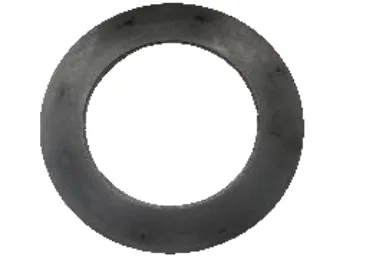
Semicera’s CFC thermal insulation cover features the following specifications
Density: 1.25 g/cm³
Tensile strength:160 MPa
Flexural strength of 120 MPa.
Many suppliers achieve a density of 1.35 g/cm³ with tensile strength ≥150 MPa and flexural strength ≥120 MPa. Through continuous process optimization and accumulated manufacturing expertise, Semicera has achieved lower material density and higher tensile strength while maintaining excellent structural integrity. This performance combination helps reduce component weight, minimize thermal inertia, and meet stringent requirements for structural stability and service life under various thermal conditions.
Select Semicera!
Semicera is a manufacturing company specializing in advanced ceramics and high-temperature materials, boasting a comprehensive production system that covers everything from raw material preparation and molding to sintering, precision machining, and surface treatment.
The company possesses comprehensive capabilities, including silicon carbide ceramic production (CFC), graphite material processing, precision mechanical machining, SiC coating treatment, and a robust quality control system. Leveraging its proprietary manufacturing platform, Semicera ensures end-to-end control over materials, processes, and product quality, guaranteeing consistent performance and reliability.
Furthermore, tailored to customers’ specific application requirements, the company provides customized support in structural design, material selection, and process optimization, serving extensively across sectors such as semiconductors, photovoltaics, high-temperature heat treatment, and advanced equipment manufacturing.
Through continuous process improvements and scalable production capabilities, Semicera is committed to delivering high-temperature structural material solutions characterized by stable performance, reliable quality, and efficient delivery.