
CFC Heating Element: Why It Is the True Core Heat Source of High-Temperature Thermal Fields
Written by Lucy@ Semicera.
Carbon Fiber Composite (CFC) heating elements are the primary heat source in high-temperature thermal fields, converting electrical energy directly into heat while maintaining exceptional structural stability. Unlike conventional CFC structural components that mainly provide support or insulation, CFC heating elements must also deliver precise electrical conductivity, uniform heat distribution, and long-term reliability under extreme temperatures. Their unique three-dimensional carbon fiber-reinforced structure provides superior toughness, crack resistance, lightweight performance, and thermal shock resistance compared with traditional graphite heating elements. In this article, we explore the working principles, structural advantages, and key differences of CFC heating elements, as well as how Semicera’s advanced manufacturing technology enhances their performance for semiconductor crystal growth, vacuum heat treatment, and high-temperature sintering applications.
Definition
The CFC heating element, as the name suggests, generates heat through electrical current and directly serves as the “core heat source” within the thermal field.
The key difference between a CFC heating element and a conventional CFC component lies in the fact that it must not only meet structural requirements but also fulfill electrical heating functionality.
Since the CFC heating element must consistently convert electrical energy into thermal energy upon power supply, critical factors such as resistivity, heat distribution uniformity, and current path must be carefully considered, making it significantly distinct from other CFC components.
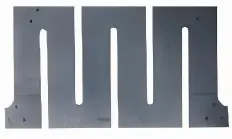
The fundamental difference between CFC heating elements and ordinary CFC structural components:
Standard CFC thermal field components—such as CFC top plates, cover plates, baffles, support structures, and clamps—primarily serve functions including load-bearing and structural support, thermal insulation and heat retention, flow obstruction and guidance, fixation of workpieces or crucibles, and maintenance of thermal field integrity.
A conventional graphite heating element consists of a single solid carbon block without any internal support fibers, classified as a purely brittle material that will fracture completely upon crack initiation. In contrast, the CFC heating element employs a pre-woven three-dimensional fibrous matrix of carbon fibers, which is then filled with carbon substrate, effectively embedding fine, high-strength carbon fibers throughout the block. This configuration achieves a qualitative improvement in both toughness and crack resistance.
The design offers three major practical advantages:
1. Automatic crack arrest prevents a complete fracture
Even after prolonged high-temperature use, when minor cracks develop in the material, the internal carbon fibers effectively contain them, preventing further propagation—unlike graphite heating elements that may shatter completely and fail entirely.
2. Customizable heating performance
By adjusting the density and direction of carbon fiber weaving, users can precisely control heating rate and target areas, enabling localized furnace heating and zoned temperature regulation—a capability unattainable with conventional monolithic graphite or metal heating elements.
3. Reduced weight for improved furnace load-bearing capacity
At equivalent dimensions, CFC heating elements are over 30% lighter than graphite counterparts, placing less stress on furnace support structures, reducing wear on components, and making them suitable for a wider range of compact high-temperature applications.
The internal carbon fiber skeleton forms the foundation of all advantages of CFC heating elements and represents their most fundamental distinction from conventional carbon-based heating components.
Semicera’s CFC Heating Element
The Semicera CFC heating element features a three-dimensional woven structure with a high proportion of carbon fibers. Utilizing thermal pressing combined with resin impregnation densification processes, it significantly reduces the production cycle. Through precise control of its internal microstructure, the material’s resistivity is effectively enhanced.
Measured material parameters:
Density: 1.5 g/cm³
Flexural strength: 210 MPa
Resistivity consistent: 18–22 × 10⁻⁵ Ω·m.
Under identical density conditions, the overall mechanical properties of this product significantly surpass those of CFC materials produced solely by gas-phase infiltration.
The integrated tooth structure ensures uniform current distribution, stable heat generation, and strong resistance to thermal shock. It remains resistant to cracking or deformation under prolonged high-temperature cycling, making it highly suitable for use in semiconductor vacuum heating systems and high-temperature sintering furnaces.