
SiC-Coated Graphite Susceptor: A Complete Guide
By Lucy Zhang (Sales) @ semicera semiconductor technology co., ltd.
The SiC-coated graphite substrate is a semiconductor component used for supporting and heating single-crystal substrates in MOCVD (metal organic chemical vapor deposition) equipment. As the name suggests, this component consists of two parts: a graphite substrate and a silicon carbide coating. We will now examine it step by step.
What is a graphite base?
The base, also known as a “tray”, is shown in Figure 1. It serves as the core high-temperature load-bearing or heating component in semiconductor manufacturing.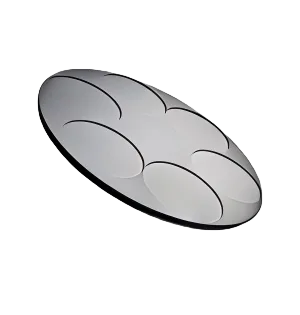
Performance Features:
The base of the graphite base is ultra-high-purity isostatic graphite.(Figure 2)
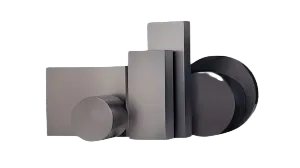
Graphite features a purity of 5N–6N with low ash content, meaning it is high-purity and low-impurity. It is isotropic, with a nearly consistent thermal expansion coefficient in all directions. This ensures minimal deformation and no cracking during heating or cooling at high temperatures. It also matches well with the silicon carbide coating introduced later, preventing coating peeling caused by mismatched expansion.
Although the graphite structure is dense with low porosity, it still contains tiny pores. Gases can penetrate through these pores, affecting product quality. Graphite also tends to generate dust, which contaminates wafers.
Graphite can withstand temperatures above 2000°C in non-oxidizing environments, but it is not resistant to corrosion by NH₃, HCl, and so on. In the presence of oxygen, it oxidizes and erodes at high temperatures, leading to dimensional shrinkage.
In summary, in oxidizing environments where long service life and corrosion resistance are required, pure graphite susceptors have more disadvantages than advantages. Therefore, a coating is needed to overcome these weaknesses.
There are many types of coatings, each serving different purposes. Among them, silicon carbide (SiC) coating offers the best overall performance and cost-effectiveness, as it simultaneously provides wear resistance, corrosion resistance, good thermal matching, high purity protection, high thermal conductivity, and high density.
Why choose silicon carbide coating?
We now provide a detailed introduction to the silicon carbide coating, to better understand why it is essential.
SiC Coating:
It is a dense, high-purity polycrystalline β-SiC coating, made by the CVD (Chemical Vapor Deposition) method on the surface of high-purity isotropic graphite. It has key features like oxidation resistance, wear resistance, corrosion resistance, high density, high temperature resistance, high thermal conductivity and ultra-high purity. It is the standard protective solution for graphite susceptors in third-generation semiconductor epitaxy processes.
Key Characteristics:
Oxidatieweerstand: It stays stable at temperatures up to 1600℃ in environments with oxygen, and oxidizes much slower than pure graphite. At high temperatures, it does not lose weight or shrink due to oxidation or structural changes, which greatly extends the service life of the susceptor.
Draag weerstand: SiC has a high hardness of HV 2800–3300. Its surface is dense and as smooth as a mirror, which completely stops dust from falling off the graphite, prevents particle contamination, and improves the yield of epitaxial wafers significantly.
Corrosieweerstand: In high-temperature epitaxy environments, it can stably resist corrosive gases such as NH₃, HCl, and MO sources (like TMGa, TMAl). It is chemically stable, with no reaction, dissolution or corrosion.
Dikte: The SiC coating made by CVD is dense and continuous, with no visible pores or pinholes. It fully covers and seals the graphite substrate, stops process gases from seeping in and impurities from spreading, and fundamentally prevents wafer contamination.
High Temperature Resistance: It can work stably for a long time at up to 1600℃ (in environments with oxygen) and above 1800℃ (in inert gas environments). At high temperatures, it does not soften, decompose or change its structure.
Thermal Conductivity: SiC has a thermal conductivity of 120–150 W/(m·K). It can transfer heat quickly and evenly, ensuring the temperature on the wafer surface is uniform.
The high-purity SiC coating contains less than 1 ppm of total metallic impurities, and less than 1 ppb of radioactive elements such as U and Th. At high temperatures, no impurities are released and no metal contamination occurs, meeting the strict cleanliness requirements for semiconductor epitaxy.
In addition, the thermal expansion coefficient of SiC (4.5–5.0×10⁻⁶/℃) is very close to that of high-purity isotropic graphite (4.0–6.0×10⁻⁶/℃). This means there is very little stress between the coating and the graphite during repeated heating and cooling cycles, so the coating does not crack or peel off, and has strong adhesion. Under standard mass production conditions, the SiC coating can extend the service life of the susceptor by 5–10 times, greatly reducing the frequency of replacement and downtime, and its overall use cost is much lower than that of pure graphite susceptors.
Why is it necessary to add a silicon carbide coating on the graphite substrate?
To better understand the performance difference between graphite substrates with SiC coating En graphite substrates without SiC coating, we have listed some key data in a table for a more direct and clear comparison.
|
Performance Indicator |
Graphite Susceptor without SiC Coating |
SiC-coated graphite susceptor |
|
Purity |
5N-6N, ash content ≤5ppm |
5N-6N, ash content ≤1ppm |
|
Hardheid |
HV 80-120 |
HV 2800-3200 |
|
High Temperature Resistance |
2000-2200℃ in non-oxidizing environments; ≤800℃ in oxidizing environments |
1200-1400℃ in non-oxidizing environments; ≤1600℃ in oxidizing environments, stable without decomposition |
|
Oxidatieweerstand |
Arm easy to oxidize and shrink in high-temperature oxidizing environments |
Uitstekend no oxidation weight loss or dimensional shrinkage below 1600℃ |
|
Corrosieweerstand |
Arm easy to be corroded and pulverized by NH₃, HCl, MO sources, etc. |
Uitstekend stably resists strong corrosive gases such as NH₃, HCl, TMGa, TMAl |
|
Dikte |
Porosity 5%-8%, gas permeability ≥1.2×10⁻⁸ cm²/s |
Porosity ≤0.5%, gas permeability ≤5×10⁻¹² cm²/s, no obvious pores |
|
Thermal Conductivity |
80-120 W/(m·K), in-plane vs out-of-plane difference ≥20% |
120-150 W/(m·K), in-plane vs out-of-plane difference ≤5% |
|
Surface State |
Surface roughness Ra≥0.8μm, prone to dusting, no protection |
Surface roughness Ra≤0.1μm, CVD-prepared β-SiC coating, no dusting |
|
Leven in dienst |
3-6 months thermal cycles ≤50 times |
18-24 months thermal cycles ≥500 times |
Silicon carbide coating manufacturing process:
There are multiple methods for preparing silicon carbide coatings, including the sol-gel method, spray coating, ion beam spraying, chemical vapor reaction (CVR), and chemical vapor deposition (CVD). Among these, chemical vapor deposition (CVD) is currently the predominant technique for SiC coating preparation.
CVD:
Principle:
A silicon-containing gas source (e.g., methyl trichlorosilane MTS, silane SiH₄) is mixed with a carbon-containing gas source (e.g., propane C₃H₈, acetylene C₂H₂) in a specified ratio. The mixture undergoes pyrolysis in a high-temperature reactor, resulting in the chemical formation of SiC films on the substrate surface through chemical reactions.
Characteristics:
1. The coating is the most dense, free of pinholes
2. High bonding strength to the substrate, and allows precise control of thickness and purity.
3. It represents the only mainstream process for semiconductor substrates.
4. Typical parameters: deposition temperature 1100–1350°C, coating thickness 5–20 μm.
Market Status
Currently, the global SiC-coated graphite substrate market is dominated by companies from Europe, America, and Japan, with Germany’s SGL Carbon and Japan’s Toyo Tanso being industry leaders that have long held major shares in the global market. These two companies stand out in the semiconductor-grade SiC-coated graphite substrate sector due to their mature CVD coating technology and high-purity graphite substrate advantages, with their products widely used in global MOCVD equipment and SiC epitaxy processes. China has now broken through the core technology of uniformly growing SiC coatings on graphite substrates, with their quality validated by domestic and international clients. Additionally, they possess certain price competitiveness, meeting the requirements of MOCVD equipment for SiC-coated graphite substrates.
Semicera’s SiC-coated Graphite susceptor
Semicera has dedicated over a decade to silicon carbide coating technology, achieving remarkable success while offering bespoke customization services to meet personalized needs. With continuous technological advancements, we have introduced the same buffer layer technology as SGL. Through specialized processing techniques, a buffer layer is added between graphite and silicon carbide, resulting in a service life more than tripled.